> ## Documentation Index
> Fetch the complete documentation index at: https://docs.assetinfinity.ai/llms.txt
> Use this file to discover all available pages before exploring further.
# Reliability
> Is the fleet getting better or worse, which machines are the problem, and what should be done about them.
Three questions, in the order somebody walking into a plant asks them.
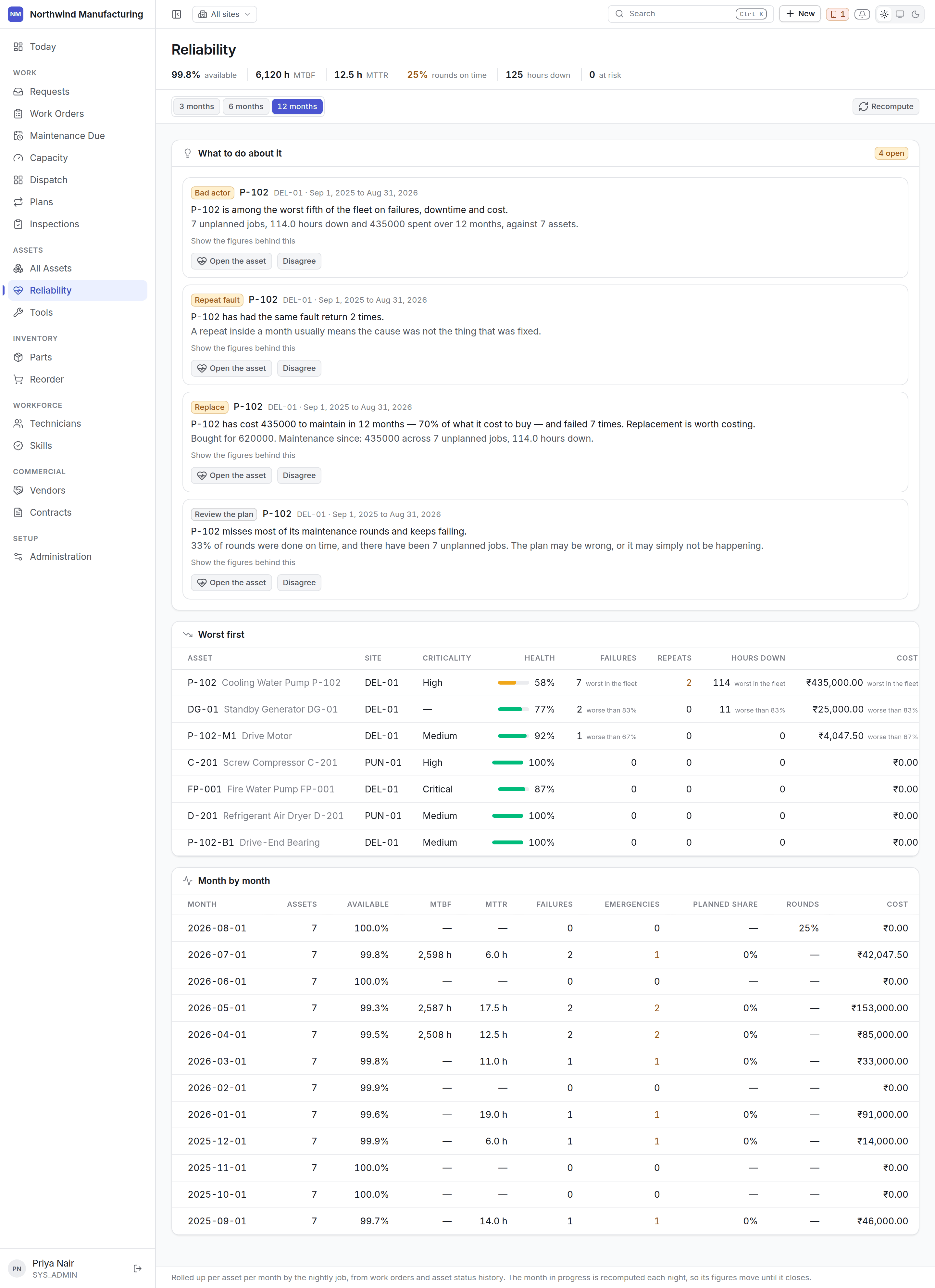 ## Recommendations
First on the screen even though it is the smallest section, because it is the only part that says
anything *ought to happen* — and therefore the only part you can disagree with.
A recommendation reads like an argument:
> *P-102 has cost 435,000 to maintain in twelve months — 70% of what it cost to buy — and failed 7
> times. Replacement is worth costing.*
Each one carries the evidence it was built from. You can **accept** a recommendation, which records
that somebody agreed and what they intend to do, or **dismiss** it with a reason.
Typical recommendations:
| Kind | Trigger |
| ----------------------------------- | --------------------------------------------- |
| **Consider replacement** | Maintenance cost approaching replacement cost |
| **Review the maintenance strategy** | Repeated failures despite a plan running |
| **Increase frequency** | Failures clustering between scheduled rounds |
| **Reduce frequency** | Rounds consistently finding nothing wrong |
| **Investigate** | A failure pattern with no obvious cause |
An *Investigate* recommendation is what opens an investigation on
[Root cause](/assets/root-cause), which is where the pattern is worked through and the actions that
come out of it are followed until somebody can say whether they worked.
## Bad actors
The machines costing you the most, ranked.
The percentiles are the point, not decoration. "Seven failures" means nothing until it is *"seven
failures — worse than 96% of the fleet"*. A ranking against the whole fleet is something only the
server can compute; a browser holding one page of rows could not.
Each row carries failures, downtime hours, maintenance cost, MTBF and health, with the percentile
beside each.
## The trend
Whether the fleet is improving. Availability, MTBF, MTTR, PM compliance and downtime over time.
Read over the window rather than the newest month — the current month is a few days old and always
reads as a perfect one.
## The measures
| Measure | Meaning |
| ----------------- | --------------------------------------------- |
| **Availability** | Share of time assets were not in a down state |
| **MTBF** | Mean time between failures — higher is better |
| **MTTR** | Mean time to repair — lower is better |
| **PM compliance** | Preventive rounds done within tolerance |
| **Downtime** | Hours in a state your model counts as down |
| **Planned share** | Planned work against unplanned |
Every figure comes from the same computation the dashboards use. Nothing on this screen is
re-derived in the browser, so two screens never disagree about the same machine.
## What feeds it
Reliability is only as good as what is recorded:
* **Failures** on the jobs that fixed them — a repair with no failure teaches nothing.
* **Downtime**, via the asset being put Down rather than Under Maintenance.
* **Costs** — labour booked, parts issued.
* **Closed** work orders. Work left open is work that never reaches these figures.
## Related topics
- [Inside an asset](/assets/detail.md)
- [The asset lifecycle](/assets/lifecycle.md)
- [Working a job](/field/job.md)
- [Inspections](/maintenance/inspections.md)
- [Inside a work order](/work/work-order-detail.md)
## Recommendations
First on the screen even though it is the smallest section, because it is the only part that says
anything *ought to happen* — and therefore the only part you can disagree with.
A recommendation reads like an argument:
> *P-102 has cost 435,000 to maintain in twelve months — 70% of what it cost to buy — and failed 7
> times. Replacement is worth costing.*
Each one carries the evidence it was built from. You can **accept** a recommendation, which records
that somebody agreed and what they intend to do, or **dismiss** it with a reason.
Typical recommendations:
| Kind | Trigger |
| ----------------------------------- | --------------------------------------------- |
| **Consider replacement** | Maintenance cost approaching replacement cost |
| **Review the maintenance strategy** | Repeated failures despite a plan running |
| **Increase frequency** | Failures clustering between scheduled rounds |
| **Reduce frequency** | Rounds consistently finding nothing wrong |
| **Investigate** | A failure pattern with no obvious cause |
An *Investigate* recommendation is what opens an investigation on
[Root cause](/assets/root-cause), which is where the pattern is worked through and the actions that
come out of it are followed until somebody can say whether they worked.
## Bad actors
The machines costing you the most, ranked.
The percentiles are the point, not decoration. "Seven failures" means nothing until it is *"seven
failures — worse than 96% of the fleet"*. A ranking against the whole fleet is something only the
server can compute; a browser holding one page of rows could not.
Each row carries failures, downtime hours, maintenance cost, MTBF and health, with the percentile
beside each.
## The trend
Whether the fleet is improving. Availability, MTBF, MTTR, PM compliance and downtime over time.
Read over the window rather than the newest month — the current month is a few days old and always
reads as a perfect one.
## The measures
| Measure | Meaning |
| ----------------- | --------------------------------------------- |
| **Availability** | Share of time assets were not in a down state |
| **MTBF** | Mean time between failures — higher is better |
| **MTTR** | Mean time to repair — lower is better |
| **PM compliance** | Preventive rounds done within tolerance |
| **Downtime** | Hours in a state your model counts as down |
| **Planned share** | Planned work against unplanned |
Every figure comes from the same computation the dashboards use. Nothing on this screen is
re-derived in the browser, so two screens never disagree about the same machine.
## What feeds it
Reliability is only as good as what is recorded:
* **Failures** on the jobs that fixed them — a repair with no failure teaches nothing.
* **Downtime**, via the asset being put Down rather than Under Maintenance.
* **Costs** — labour booked, parts issued.
* **Closed** work orders. Work left open is work that never reaches these figures.
## Related topics
- [Inside an asset](/assets/detail.md)
- [The asset lifecycle](/assets/lifecycle.md)
- [Working a job](/field/job.md)
- [Inspections](/maintenance/inspections.md)
- [Inside a work order](/work/work-order-detail.md)