> ## Documentation Index
> Fetch the complete documentation index at: https://docs.assetinfinity.ai/llms.txt
> Use this file to discover all available pages before exploring further.
# Failure taxonomy
> Failure modes, mechanisms and causes — the vocabulary a technician closes a failure with and every reliability figure is grouped by.
This screen holds the failure taxonomy: what failed, how it failed and why it was allowed to. These
three lists are what a technician picks from when closing a job of a type with **Failure capture**
switched on, and what every [reliability](/assets/reliability) figure is grouped by. Open it from **Administration → Failure
taxonomy**.
If you don't see this in your navigation, your administrator can switch the module on under **Administration → Modules**, or it may not be included in your plan.
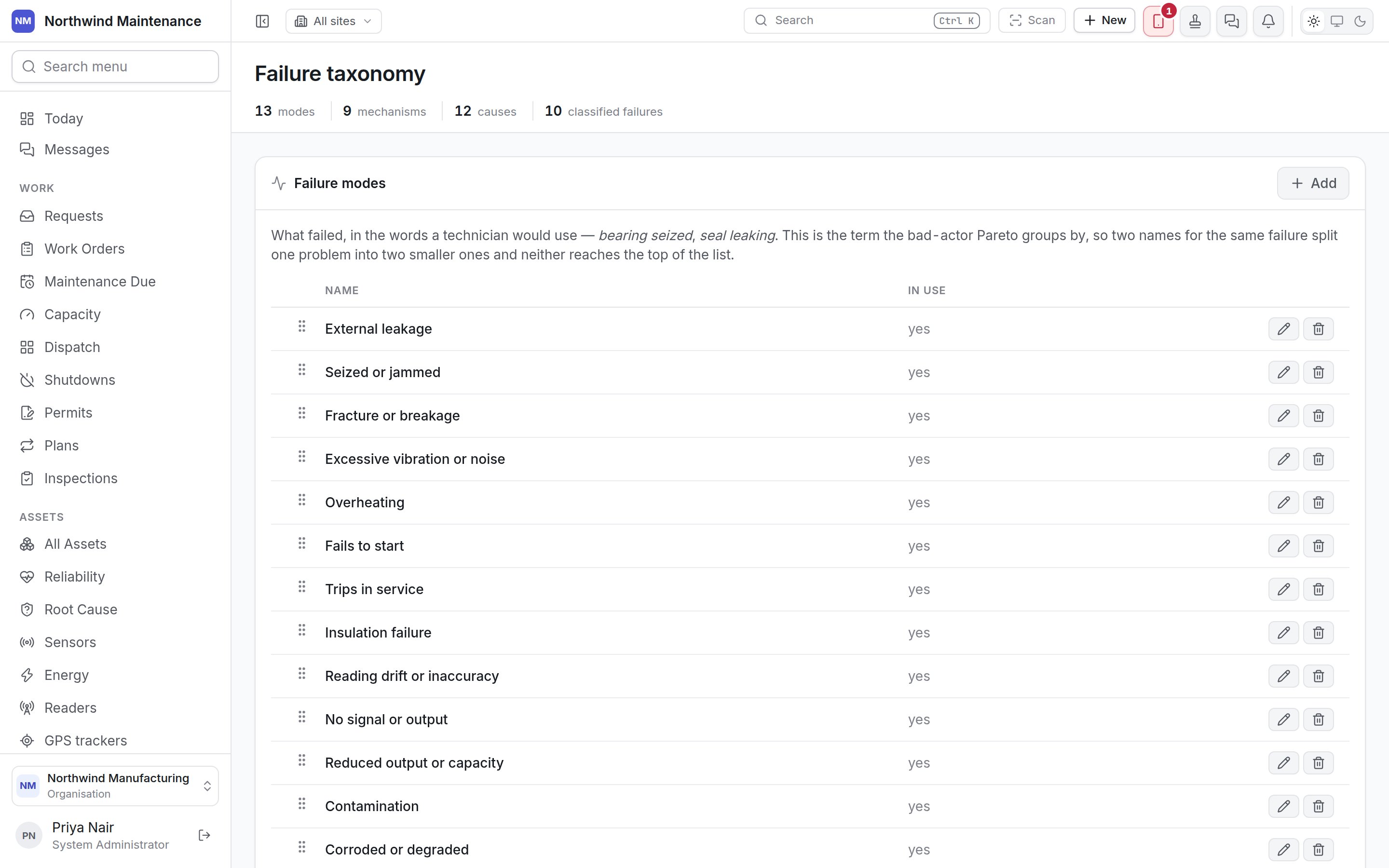
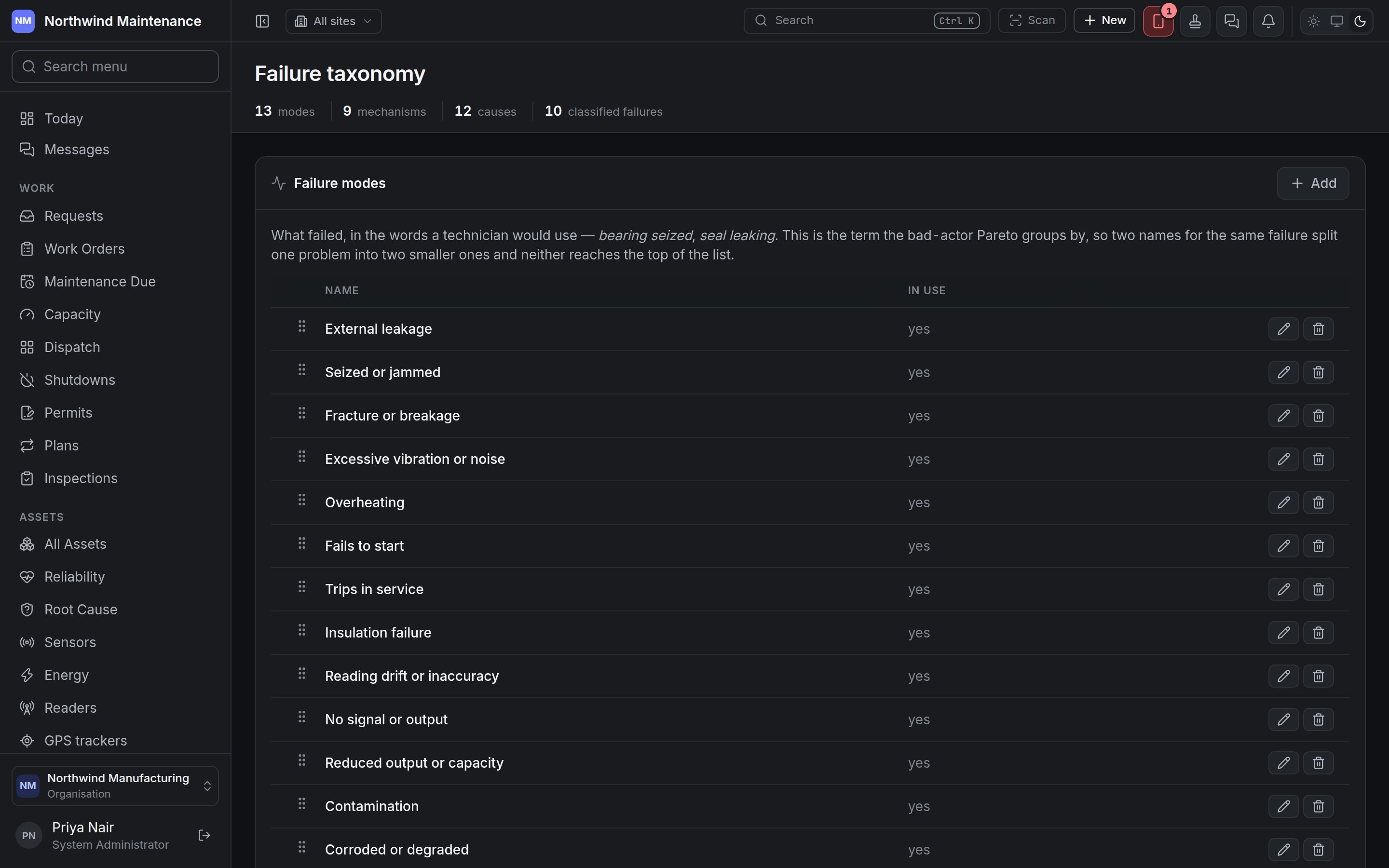 The stat strip counts **modes**, **mechanisms**, **causes** and how many failures have been
**classified** with them.
**Who can change this.** **Add configuration entries** and **Edit configuration entries**.
## The three lists
| List | Answers | Default examples |
| - | - | - |
| **Failure modes** | What failed, in the words a technician would use | External leakage, Seized or jammed, Overheating, Fails to start, Trips in service, Excessive vibration or noise |
| **Failure mechanisms** | How it failed, physically | Fatigue, Wear or abrasion, Overload, Corrosion, Erosion, Cavitation |
| **Failure causes** | Why it was allowed to happen | Incorrect installation, Misalignment or imbalance, Maintenance not carried out, Lubrication failure, Normal end of life |
Each list shows **Name** and **In use**. Drag a row to change the order it is offered in. **Add** opens
a new entry; click a row to edit it.
Two names for the same failure split one problem into two smaller ones, and neither reaches the top of
the bad-actor Pareto — the failure mode is the term it groups by. Keep mechanisms as a separate list,
because the same mode arrives by several mechanisms that need different answers. Record causes as
something somebody can change: "old age" is a cause nobody can act on.
## The form
The form is the same for all three lists.
The stat strip counts **modes**, **mechanisms**, **causes** and how many failures have been
**classified** with them.
**Who can change this.** **Add configuration entries** and **Edit configuration entries**.
## The three lists
| List | Answers | Default examples |
| - | - | - |
| **Failure modes** | What failed, in the words a technician would use | External leakage, Seized or jammed, Overheating, Fails to start, Trips in service, Excessive vibration or noise |
| **Failure mechanisms** | How it failed, physically | Fatigue, Wear or abrasion, Overload, Corrosion, Erosion, Cavitation |
| **Failure causes** | Why it was allowed to happen | Incorrect installation, Misalignment or imbalance, Maintenance not carried out, Lubrication failure, Normal end of life |
Each list shows **Name** and **In use**. Drag a row to change the order it is offered in. **Add** opens
a new entry; click a row to edit it.
Two names for the same failure split one problem into two smaller ones, and neither reaches the top of
the bad-actor Pareto — the failure mode is the term it groups by. Keep mechanisms as a separate list,
because the same mode arrives by several mechanisms that need different answers. Record causes as
something somebody can change: "old age" is a cause nobody can act on.
## The form
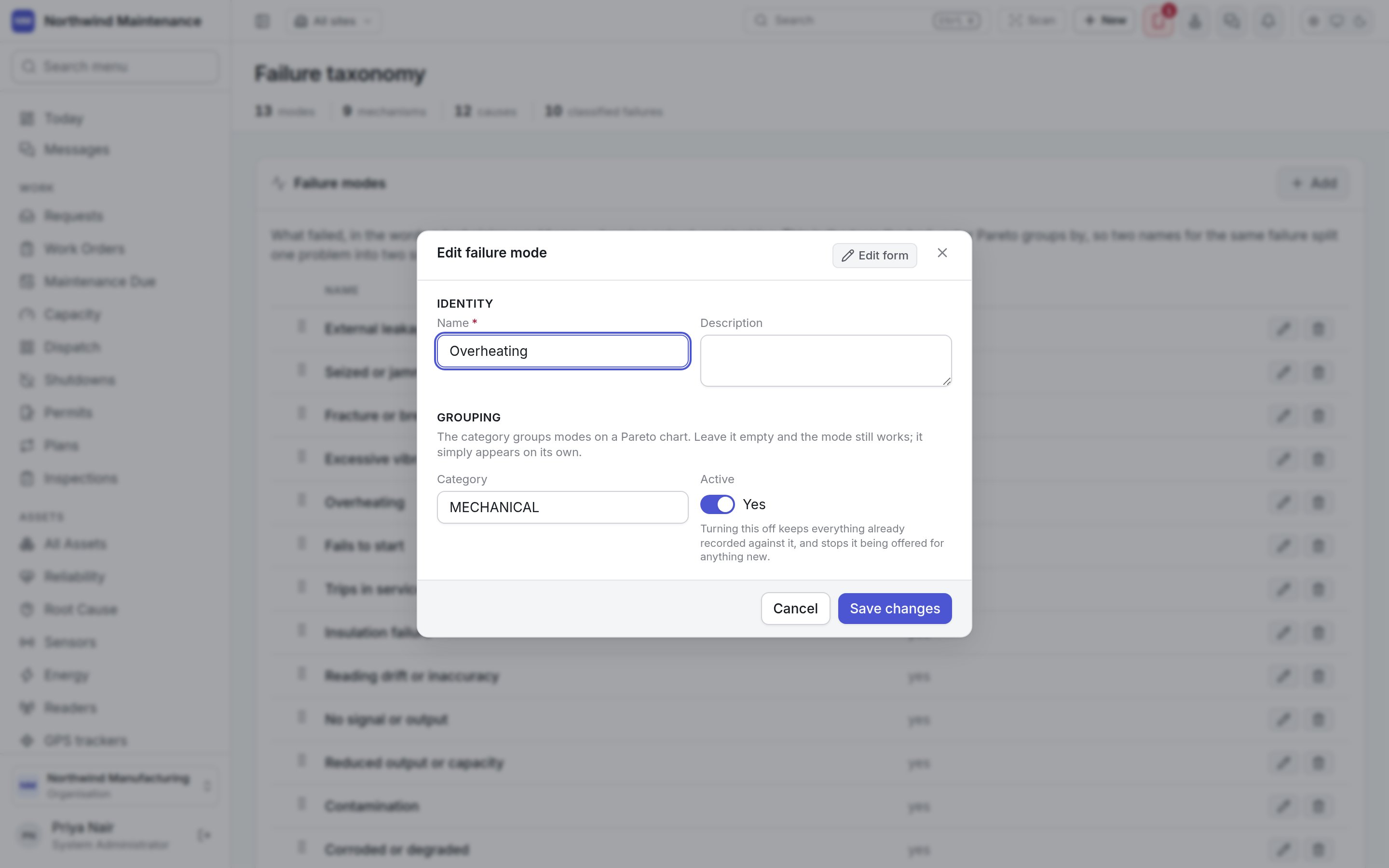
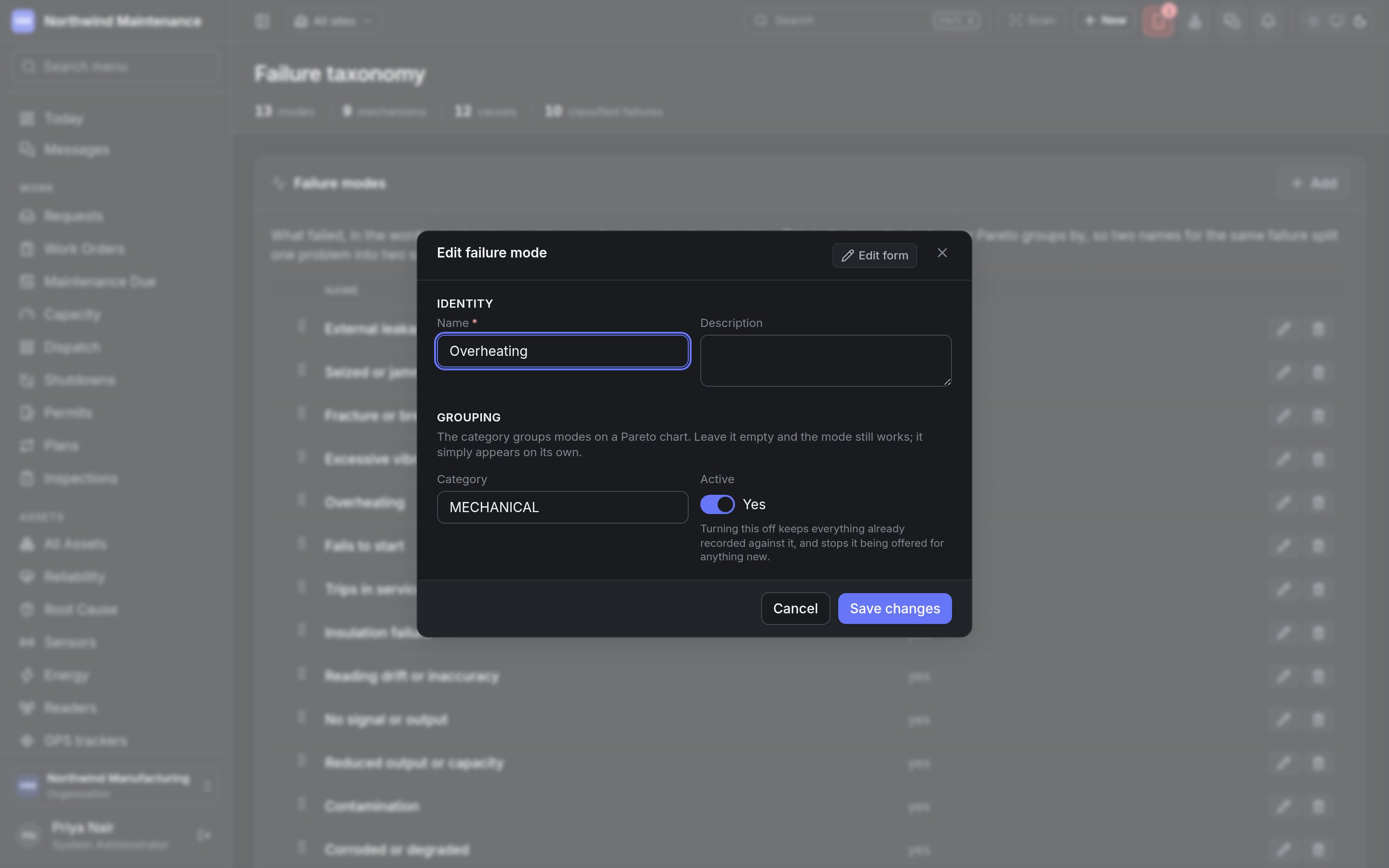
The form is the same for all three lists.
 | Field | What it means | Notes |
| - | - | - |
| **Name** | The mode, mechanism or cause | Required |
| **Description** | What it covers, so two people choose it the same way | Optional |
| **Category** | A grouping, such as MECHANICAL or ELECTRICAL | Free text. On failure modes it groups modes on a Pareto chart; leave it empty and the entry still works on its own |
| **Active** | Whether it is offered when closing a job | Turning it off keeps it on failures already classified |
## Where it is used
| Where | How |
| - | - |
| [Work order types](/config/work-orders#work-order-types) | A type with **Failure capture** demands a failure code before a job can be closed |
| [Work order detail](/work/work-order-detail) | At close-out the technician says what failed: the mode (required), then the cause and the mechanism if they know them, and the component that failed where the asset has components |
| [Reliability](/assets/reliability) | Bad-actor, repeat-failure and Pareto analysis group by these lists |
This documentation is built and hosted on [Mintlify](https://mintlify.com), a developer documentation platform.
| Field | What it means | Notes |
| - | - | - |
| **Name** | The mode, mechanism or cause | Required |
| **Description** | What it covers, so two people choose it the same way | Optional |
| **Category** | A grouping, such as MECHANICAL or ELECTRICAL | Free text. On failure modes it groups modes on a Pareto chart; leave it empty and the entry still works on its own |
| **Active** | Whether it is offered when closing a job | Turning it off keeps it on failures already classified |
## Where it is used
| Where | How |
| - | - |
| [Work order types](/config/work-orders#work-order-types) | A type with **Failure capture** demands a failure code before a job can be closed |
| [Work order detail](/work/work-order-detail) | At close-out the technician says what failed: the mode (required), then the cause and the mechanism if they know them, and the component that failed where the asset has components |
| [Reliability](/assets/reliability) | Bad-actor, repeat-failure and Pareto analysis group by these lists |
This documentation is built and hosted on [Mintlify](https://mintlify.com), a developer documentation platform.