> ## Documentation Index
> Fetch the complete documentation index at: https://docs.assetinfinity.ai/llms.txt
> Use this file to discover all available pages before exploring further.
# India: GST and depreciation
> How an Indian organisation uses the product — GST on purchase orders, invoices and budgets, GSTINs, rupee formatting, and Companies Act and Income-tax Act depreciation books side by side.
This page collects what is specific to running the product for an organisation in India: how GST is entered on purchasing documents, where GSTINs go, and how the statutory and income-tax depreciation books are kept side by side. Everything else works as described on the general pages, which link here where India differs.
Nothing here is tax advice. The product holds the rates, lives and rules you give it; confirm them
against the Act and notifications in force with your accountant before a book runs on them.
## The financial year and currency
An Indian company's financial year runs 1 April to 31 March. Set it up as a [fiscal calendar](/config/fiscal-calendars) starting in April — the India depreciation pack does this for you, as **Financial year (April–March), monthly**. Budgets, capex plans and depreciation books are all counted in that calendar.
Amounts are shown in rupees (**₹**) when the company's currency is INR. Lakh and crore grouping — ₹3,12,12,014.48 rather than ₹31,212,014.48 — follows each person's language and region setting in their own profile, so ask your people to choose an Indian English region there.
## GST registration numbers
| Where | Field | Use |
| - | - | - |
| Your company, under [organisation structure](/config/organisation-structure) | The tax registration number | Printed under the address on the letterhead of documents the product produces |
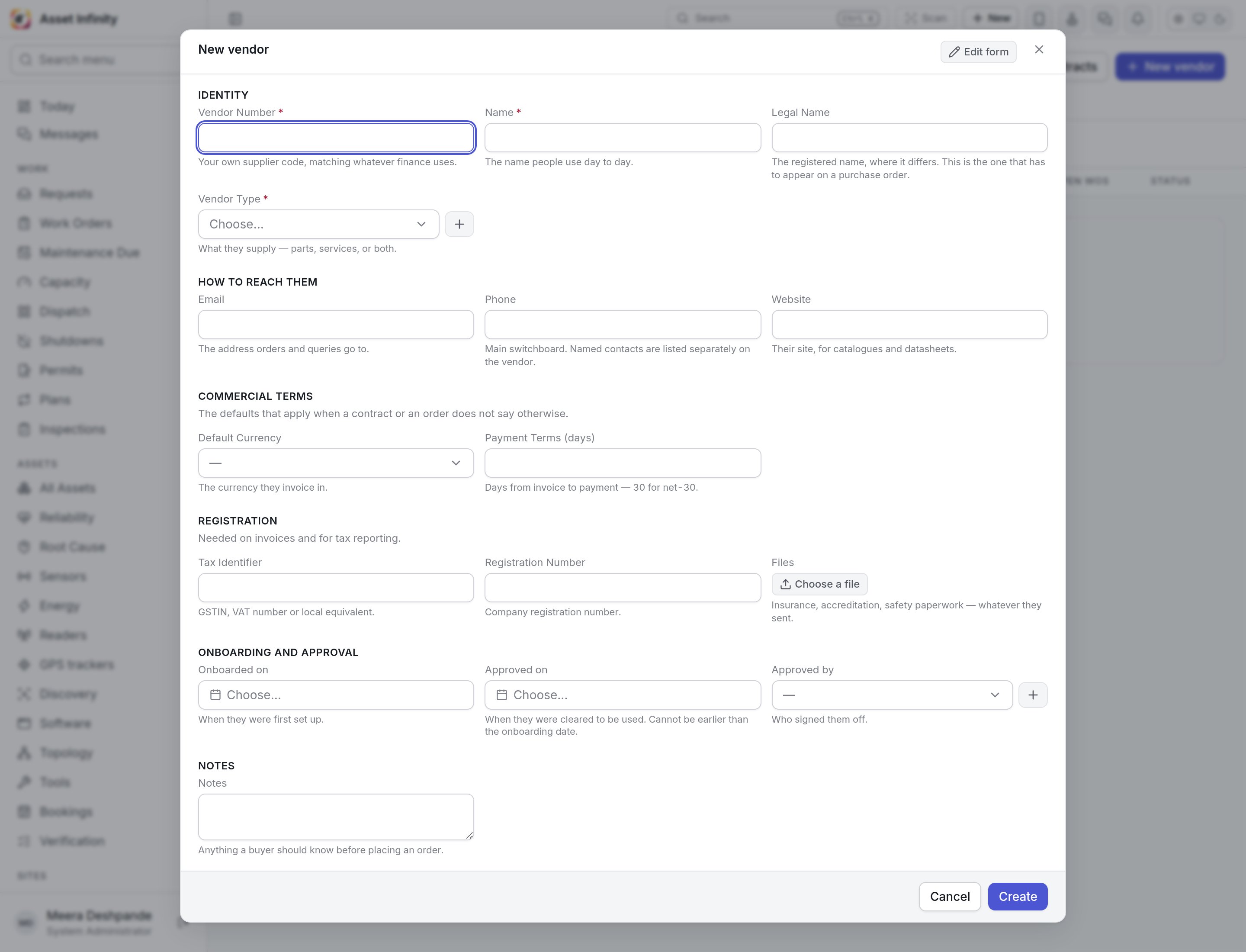
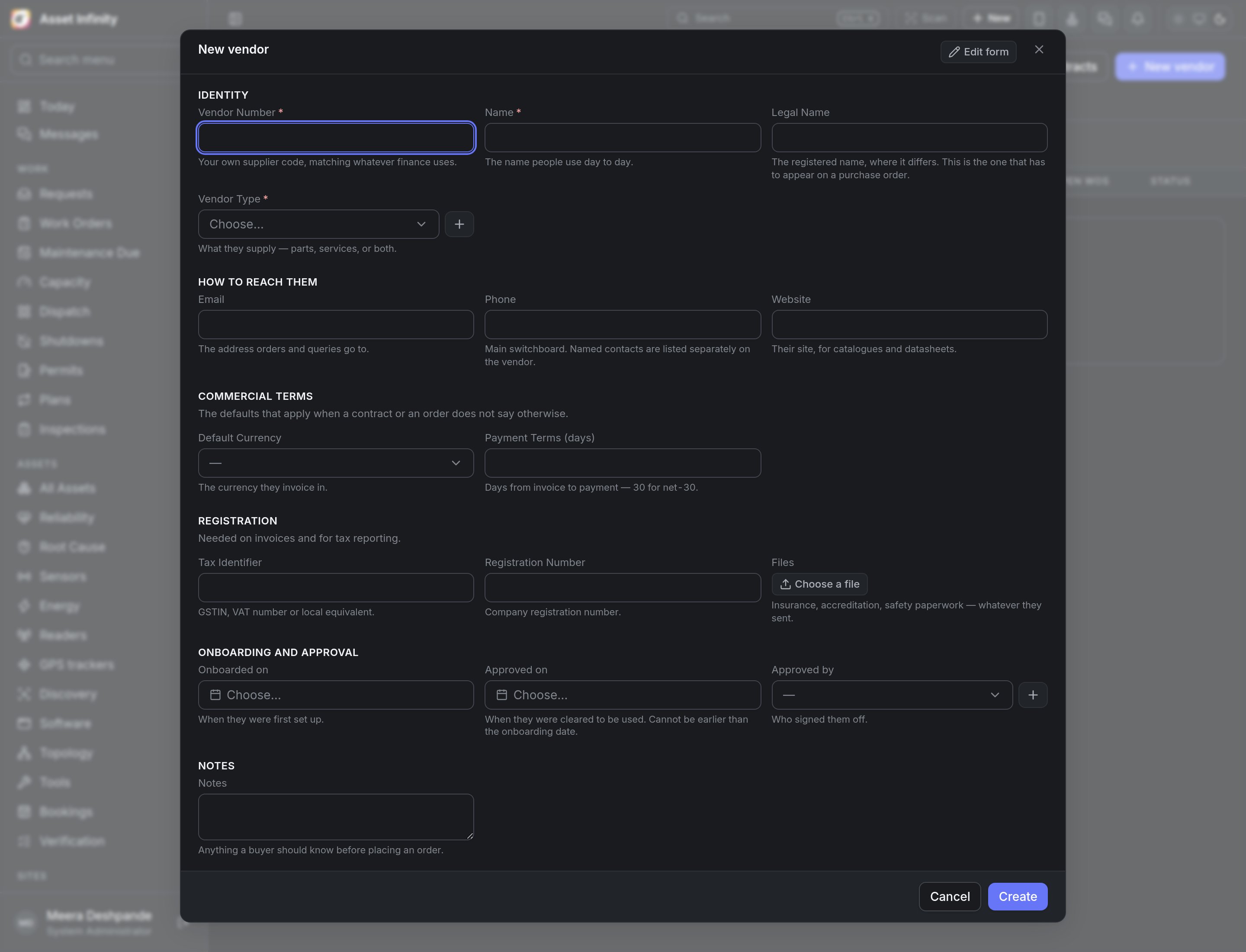
| Each vendor, on the [onboarding form](/commercial/vendors#onboarding-a-vendor) and vendor record | **Tax Identifier** — "GSTIN, VAT number or local equivalent" | Recorded for invoices and tax reporting |
 ## GST on purchase orders and invoices
 | Document | How GST is entered |
| - | - |
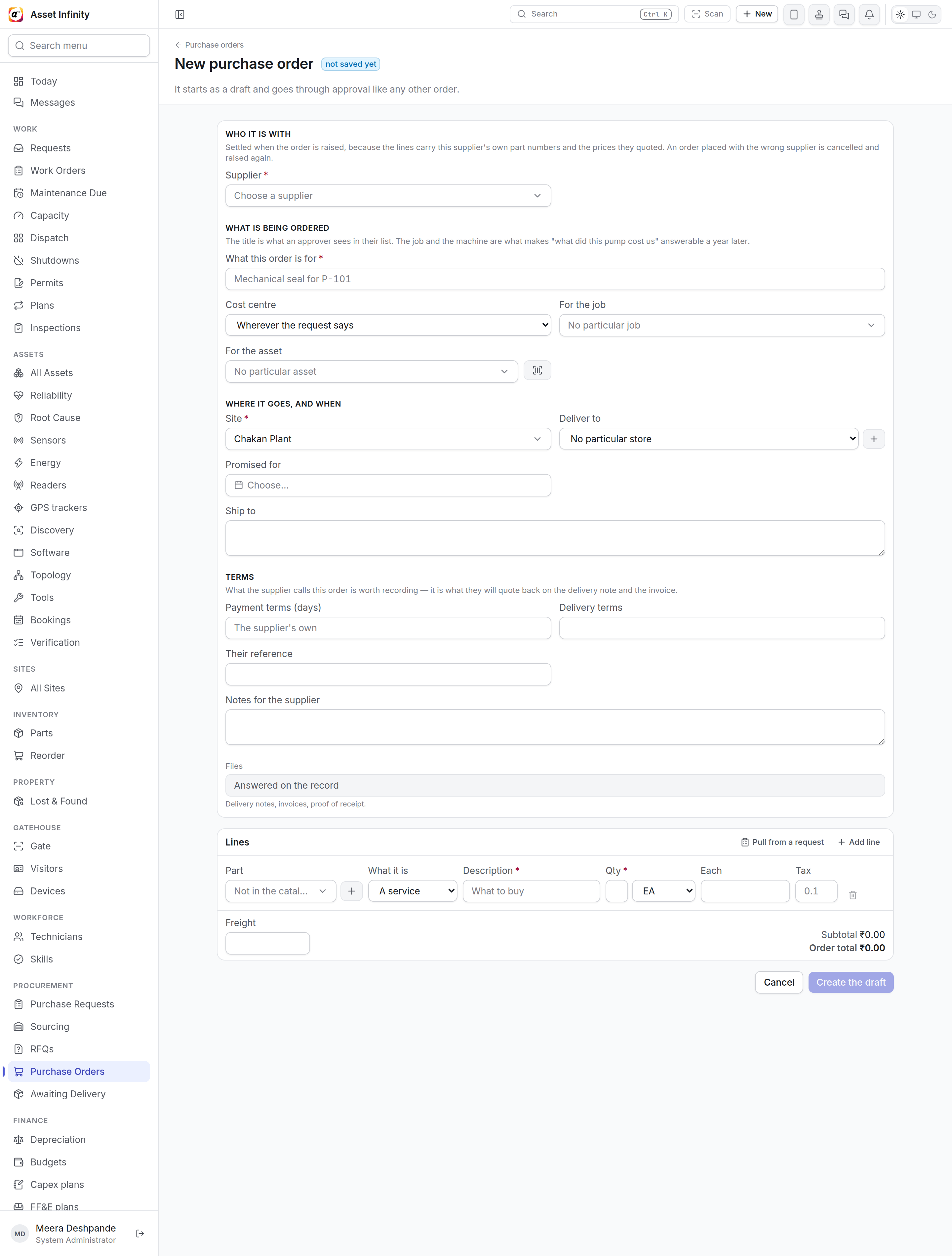
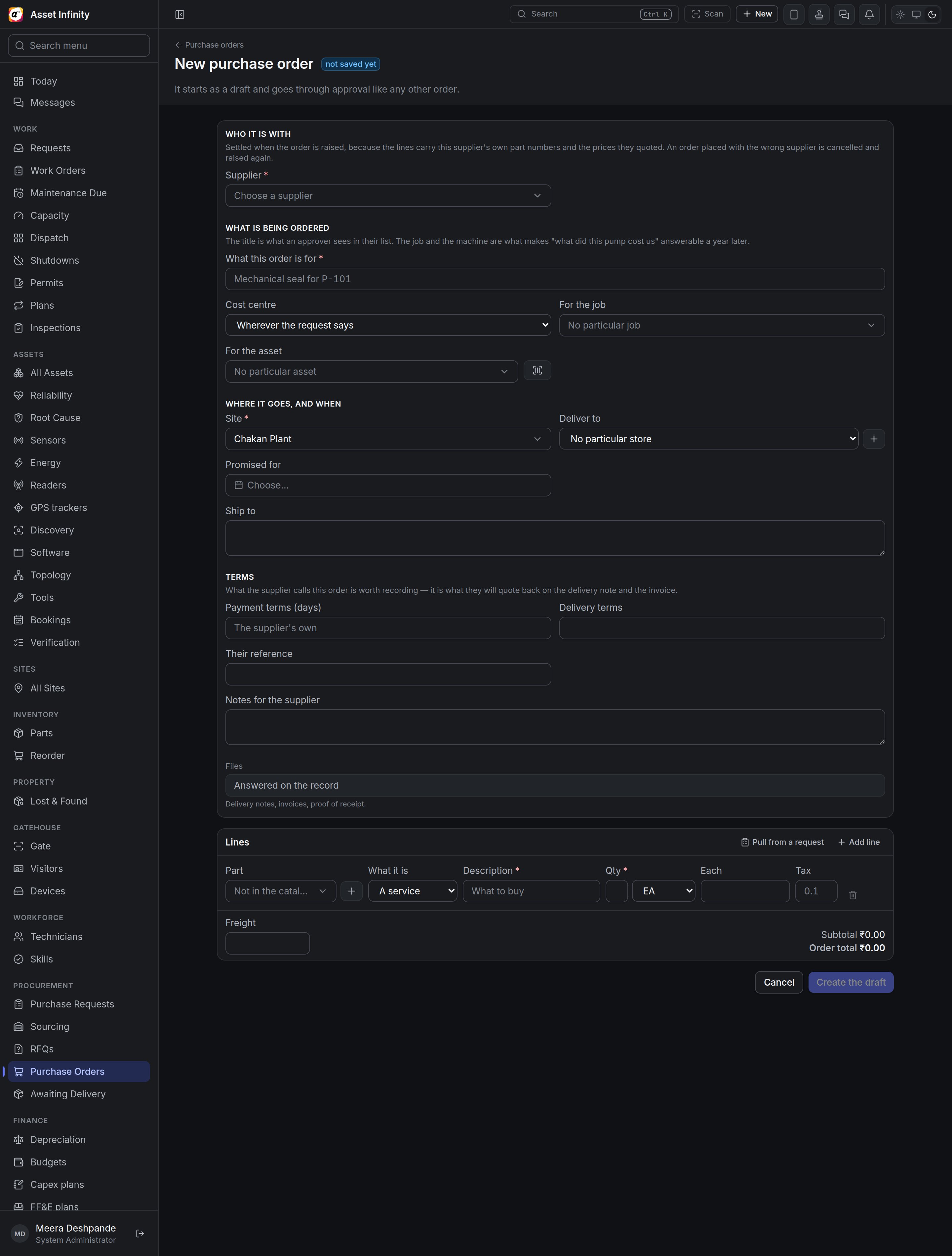
| [Purchase order](/commercial/purchase-orders#lines) line | **Tax** is the rate as a fraction: **0.18** for 18%, **0.05** for 5%, **0.28** for 28%. Each line can carry its own rate, so mixed-rate orders are fine. The order shows a **Tax** total and includes it in the **Order total** |
| [Supplier invoice](/commercial/purchase-orders#invoices-tab-three-way-matching) on an order | **Tax** is the total GST on the invoice, as an amount. The three-way match compares quantities and unit prices; tax is carried on the invoice total |
| [Vendor invoice on a job](/commercial/vendor-invoices) | Lines are entered as billed; include GST as the vendor shows it |
A line carries one combined rate. The product does not split it into CGST, SGST/UTGST and IGST, and has no HSN or SAC code fields — record the combined rate here and keep the component split, place of supply and e-invoicing in your accounting system. If you need the HSN or SAC on the record, your administrator can add a custom field to parts or order lines in [Form Studio](/config/form-studio).
### GST and budgets
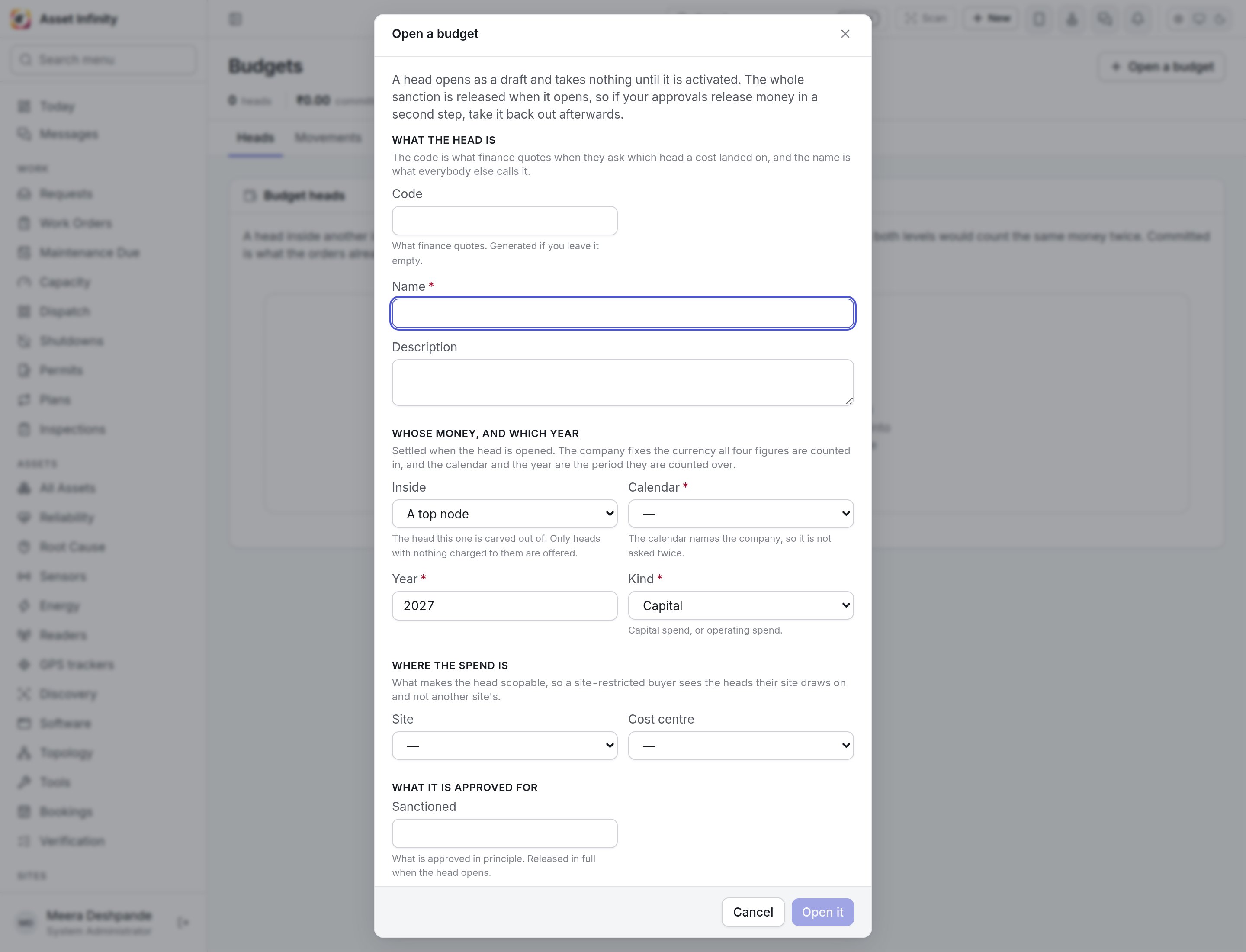
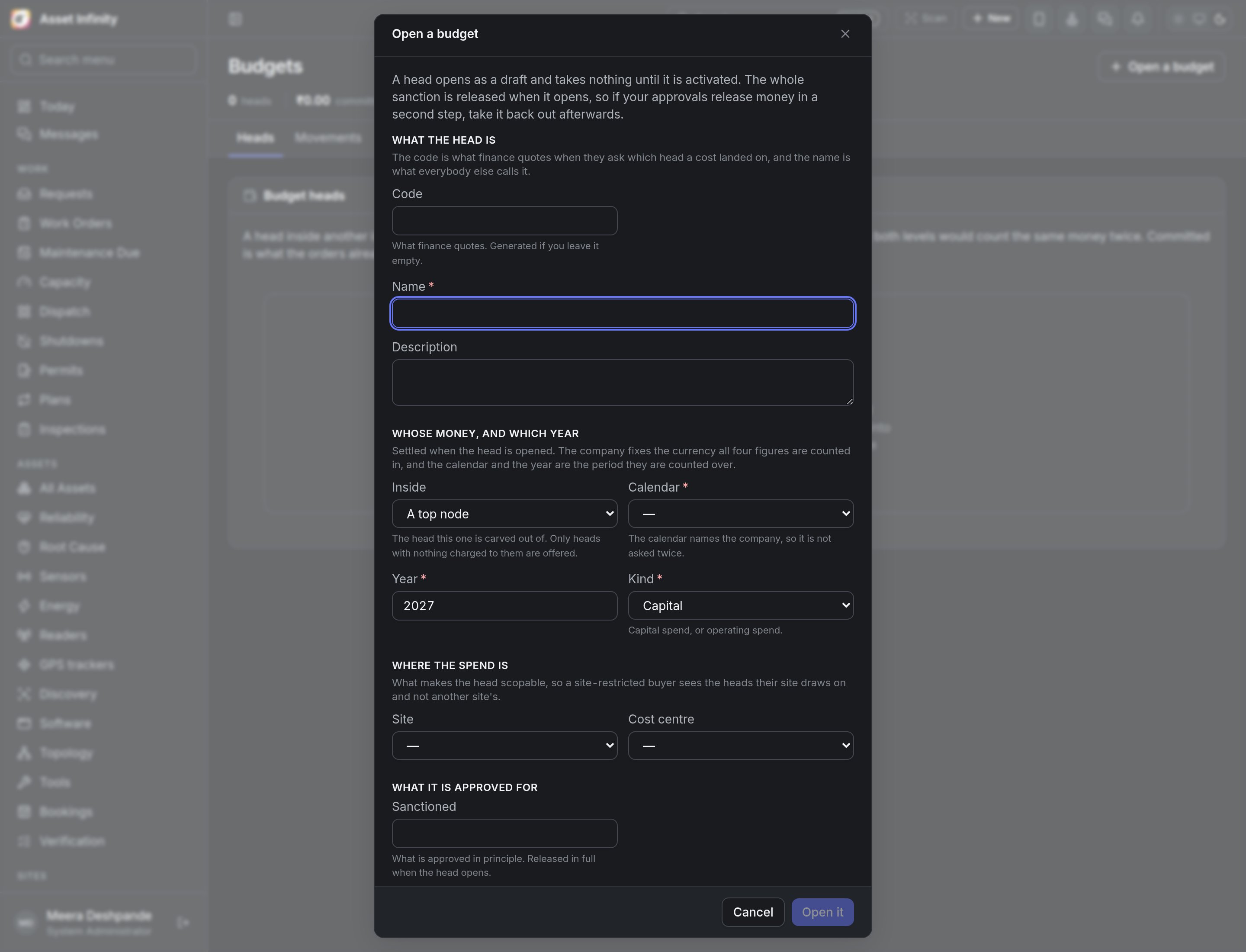
When you open a [budget head](/finance/budgets#opening-a-budget), **Counted** decides how documents consume it:
| Option | Effect | Use it when |
| - | - | - |
| **Gross of recoverable tax** | The whole document, GST included, is charged to the head | GST is a cost to you — for example ineligible input tax credit |
| **Net of recoverable tax** | The document's tax is taken off before it is charged | You claim input tax credit, so your ledger holds spend net of GST — usually the right choice for an Indian manufacturer |
Net takes off the whole tax on the document; a head cannot treat part of an order's GST as recoverable and part not.
| Document | How GST is entered |
| - | - |
| [Purchase order](/commercial/purchase-orders#lines) line | **Tax** is the rate as a fraction: **0.18** for 18%, **0.05** for 5%, **0.28** for 28%. Each line can carry its own rate, so mixed-rate orders are fine. The order shows a **Tax** total and includes it in the **Order total** |
| [Supplier invoice](/commercial/purchase-orders#invoices-tab-three-way-matching) on an order | **Tax** is the total GST on the invoice, as an amount. The three-way match compares quantities and unit prices; tax is carried on the invoice total |
| [Vendor invoice on a job](/commercial/vendor-invoices) | Lines are entered as billed; include GST as the vendor shows it |
A line carries one combined rate. The product does not split it into CGST, SGST/UTGST and IGST, and has no HSN or SAC code fields — record the combined rate here and keep the component split, place of supply and e-invoicing in your accounting system. If you need the HSN or SAC on the record, your administrator can add a custom field to parts or order lines in [Form Studio](/config/form-studio).
### GST and budgets
When you open a [budget head](/finance/budgets#opening-a-budget), **Counted** decides how documents consume it:
| Option | Effect | Use it when |
| - | - | - |
| **Gross of recoverable tax** | The whole document, GST included, is charged to the head | GST is a cost to you — for example ineligible input tax credit |
| **Net of recoverable tax** | The document's tax is taken off before it is charged | You claim input tax credit, so your ledger holds spend net of GST — usually the right choice for an Indian manufacturer |
Net takes off the whole tax on the document; a head cannot treat part of an order's GST as recoverable and part not.
 ## Depreciation: two statutes, two books
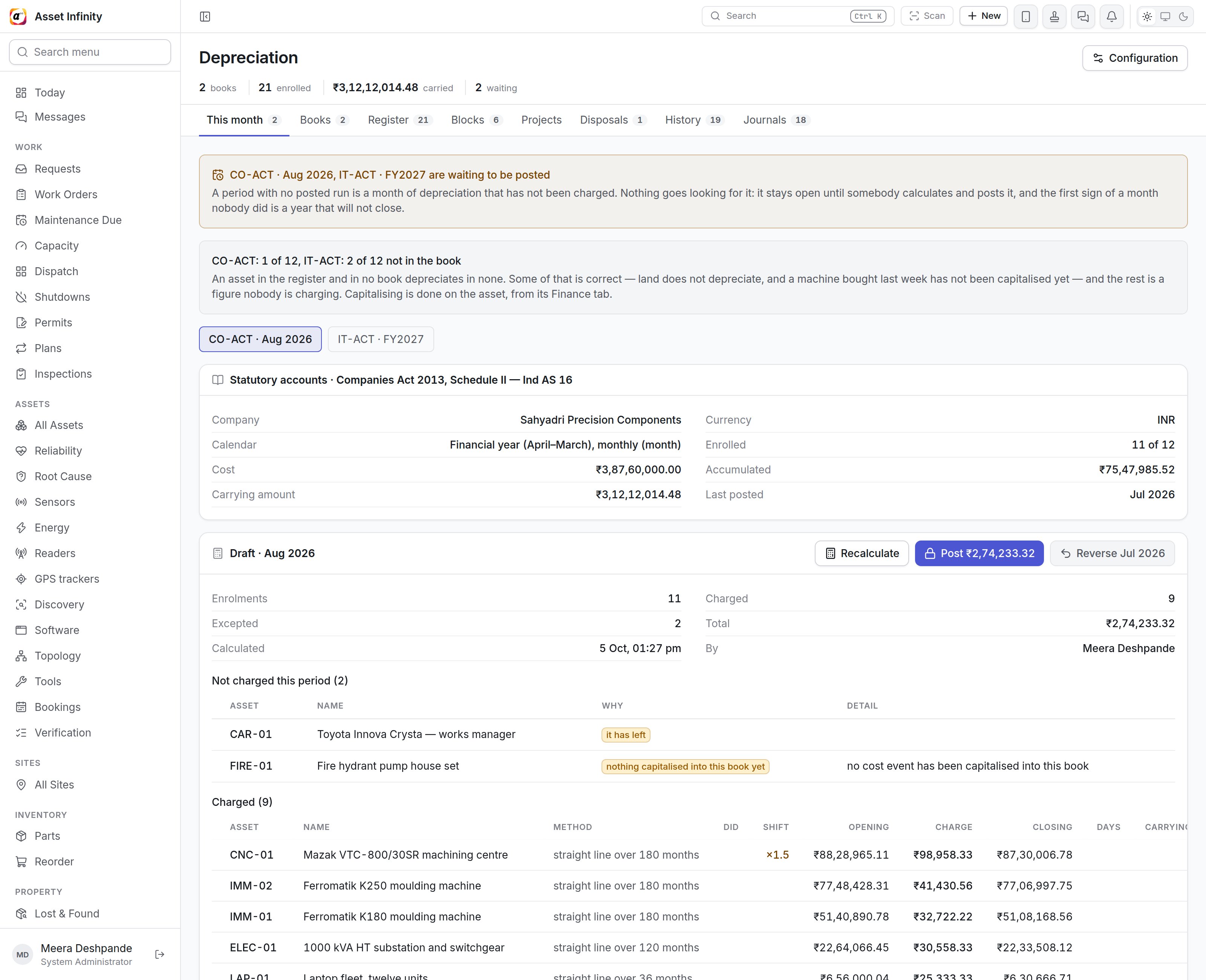
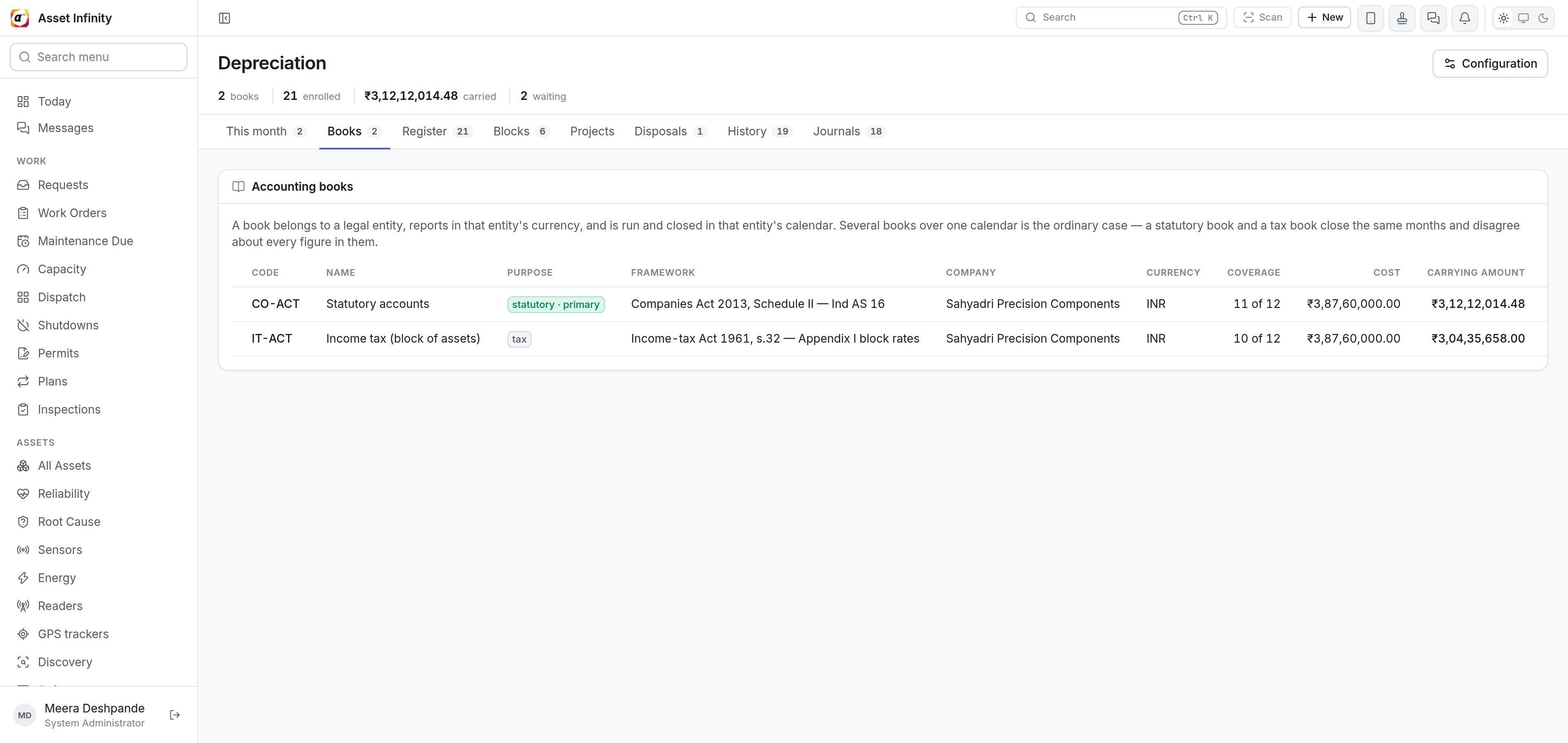
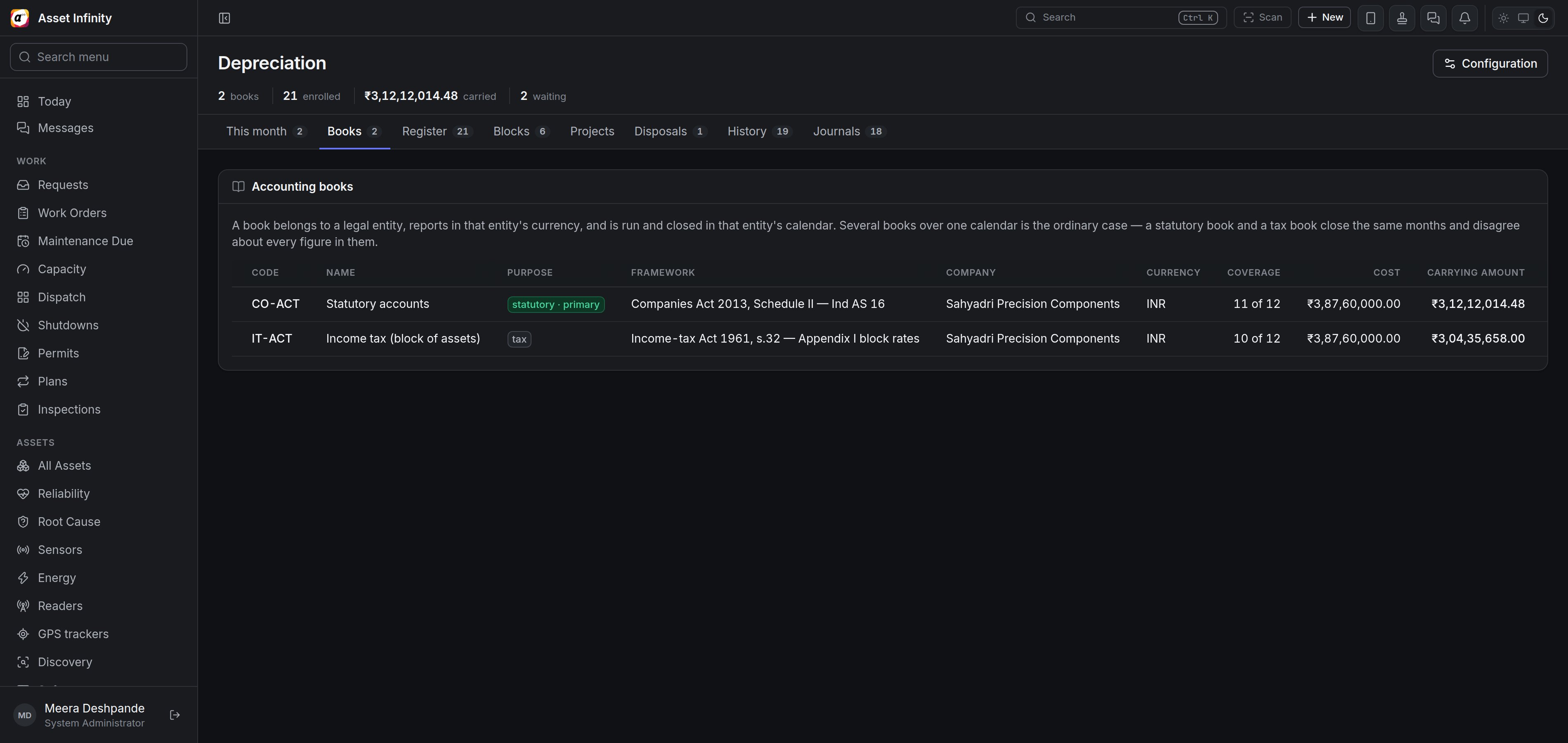
An Indian company depreciates the same fleet twice: under the Companies Act 2013 for its accounts, and under the Income-tax Act 1961 for its return. The [Depreciation](/finance/depreciation) screen keeps both books at once, and they are expected to disagree.
## Depreciation: two statutes, two books
An Indian company depreciates the same fleet twice: under the Companies Act 2013 for its accounts, and under the Income-tax Act 1961 for its return. The [Depreciation](/finance/depreciation) screen keeps both books at once, and they are expected to disagree.
 | | Statutory accounts | Income tax |
| - | - | - |
| Authority | Companies Act 2013, Schedule II — Ind AS 16 | Income-tax Act 1961, section 32 and Appendix I |
| Method | Straight line over the Schedule II useful life | Written-down value at the block rate |
| Unit | One asset | One **block of assets** per rate |
| Period | Monthly | Annual — one computation per financial year |
| Residual value | 5% of cost (the statutory cap) | None — a block depreciates towards nothing |
| First period | Pro-rata from the day the asset is put to use | Full rate if used 180 days or more in the year, half rate if fewer |
| Rounding | Paise | Whole rupees |
| Asset sold | Proceeds against carrying amount give a gain or loss | Proceeds reduce the block; no gain or loss on a single asset |
| Multiple shifts | Plant and machinery: ×1.5 for double shift, ×2 for triple shift | No equivalent |
| | Statutory accounts | Income tax |
| - | - | - |
| Authority | Companies Act 2013, Schedule II — Ind AS 16 | Income-tax Act 1961, section 32 and Appendix I |
| Method | Straight line over the Schedule II useful life | Written-down value at the block rate |
| Unit | One asset | One **block of assets** per rate |
| Period | Monthly | Annual — one computation per financial year |
| Residual value | 5% of cost (the statutory cap) | None — a block depreciates towards nothing |
| First period | Pro-rata from the day the asset is put to use | Full rate if used 180 days or more in the year, half rate if fewer |
| Rounding | Paise | Whole rupees |
| Asset sold | Proceeds against carrying amount give a gain or loss | Proceeds reduce the block; no gain or loss on a single asset |
| Multiple shifts | Plant and machinery: ×1.5 for double shift, ×2 for triple shift | No equivalent |
 ### Setting it up: the India country pack
Under [depreciation settings](/config/depreciation), a company with no book is offered **India — Companies Act and Income-tax Act**. Installing it creates in one step:
| What | Contents |
| - | - |
| Books | **Statutory accounts** (monthly, per asset, primary) and **Income tax (block of assets)** (annual, pooled) |
| Calendar | Financial year April to March |
| Schedule II classes and policies | Plant and machinery (general) 15 years, with the multi-shift uplift · Electrical installations 10 years · Furniture and fittings 10 years · Motor cars 8 years · Servers and networks 6 years · End-user computers 3 years · Factory buildings (RCC frame) 30 years — all straight line, 5% residual, charged from the day put to use |
| Income-tax blocks | Plant and machinery @ 15% (machines, vehicles and electricals together) · Computers and software @ 40% · Furniture and fittings @ 10% · Buildings @ 10% — written-down value with the 180-day rule |
After installing, two things remain before either book can post a journal:
1. Add your own depreciation expense and accumulated depreciation ledger accounts and map them to the classes.
2. Confirm the Schedule II lives against your own technical assessment (the Act allows a different life where you can justify it) and the 5% residual, which is a cap rather than a requirement.
Additional depreciation under section 32(1)(iia) is not modelled. Assets you already own arrive through cutover with an opening figure per book.
### The statutory book
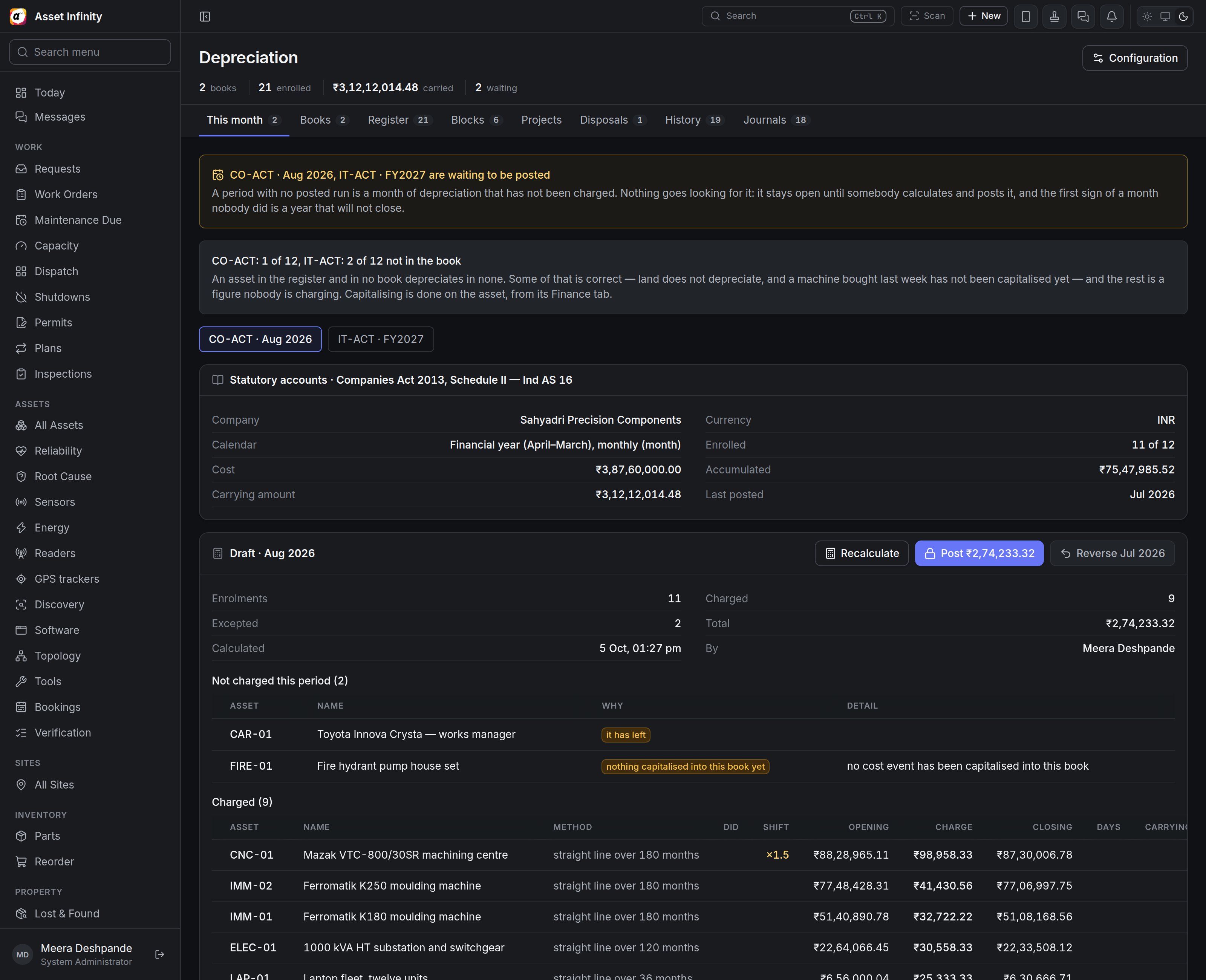
Runs monthly like any per-asset book. In the run, a plant asset that worked more than a single shift shows the factor in the **Shift** column — for example **×1.5**, with the hours it ran against the site's normal hours. The multi-shift calculation reads the asset's running-hours meter, so plant that should get the uplift needs one.
### Setting it up: the India country pack
Under [depreciation settings](/config/depreciation), a company with no book is offered **India — Companies Act and Income-tax Act**. Installing it creates in one step:
| What | Contents |
| - | - |
| Books | **Statutory accounts** (monthly, per asset, primary) and **Income tax (block of assets)** (annual, pooled) |
| Calendar | Financial year April to March |
| Schedule II classes and policies | Plant and machinery (general) 15 years, with the multi-shift uplift · Electrical installations 10 years · Furniture and fittings 10 years · Motor cars 8 years · Servers and networks 6 years · End-user computers 3 years · Factory buildings (RCC frame) 30 years — all straight line, 5% residual, charged from the day put to use |
| Income-tax blocks | Plant and machinery @ 15% (machines, vehicles and electricals together) · Computers and software @ 40% · Furniture and fittings @ 10% · Buildings @ 10% — written-down value with the 180-day rule |
After installing, two things remain before either book can post a journal:
1. Add your own depreciation expense and accumulated depreciation ledger accounts and map them to the classes.
2. Confirm the Schedule II lives against your own technical assessment (the Act allows a different life where you can justify it) and the 5% residual, which is a cap rather than a requirement.
Additional depreciation under section 32(1)(iia) is not modelled. Assets you already own arrive through cutover with an opening figure per book.
### The statutory book
Runs monthly like any per-asset book. In the run, a plant asset that worked more than a single shift shows the factor in the **Shift** column — for example **×1.5**, with the hours it ran against the site's normal hours. The multi-shift calculation reads the asset's running-hours meter, so plant that should get the uplift needs one.
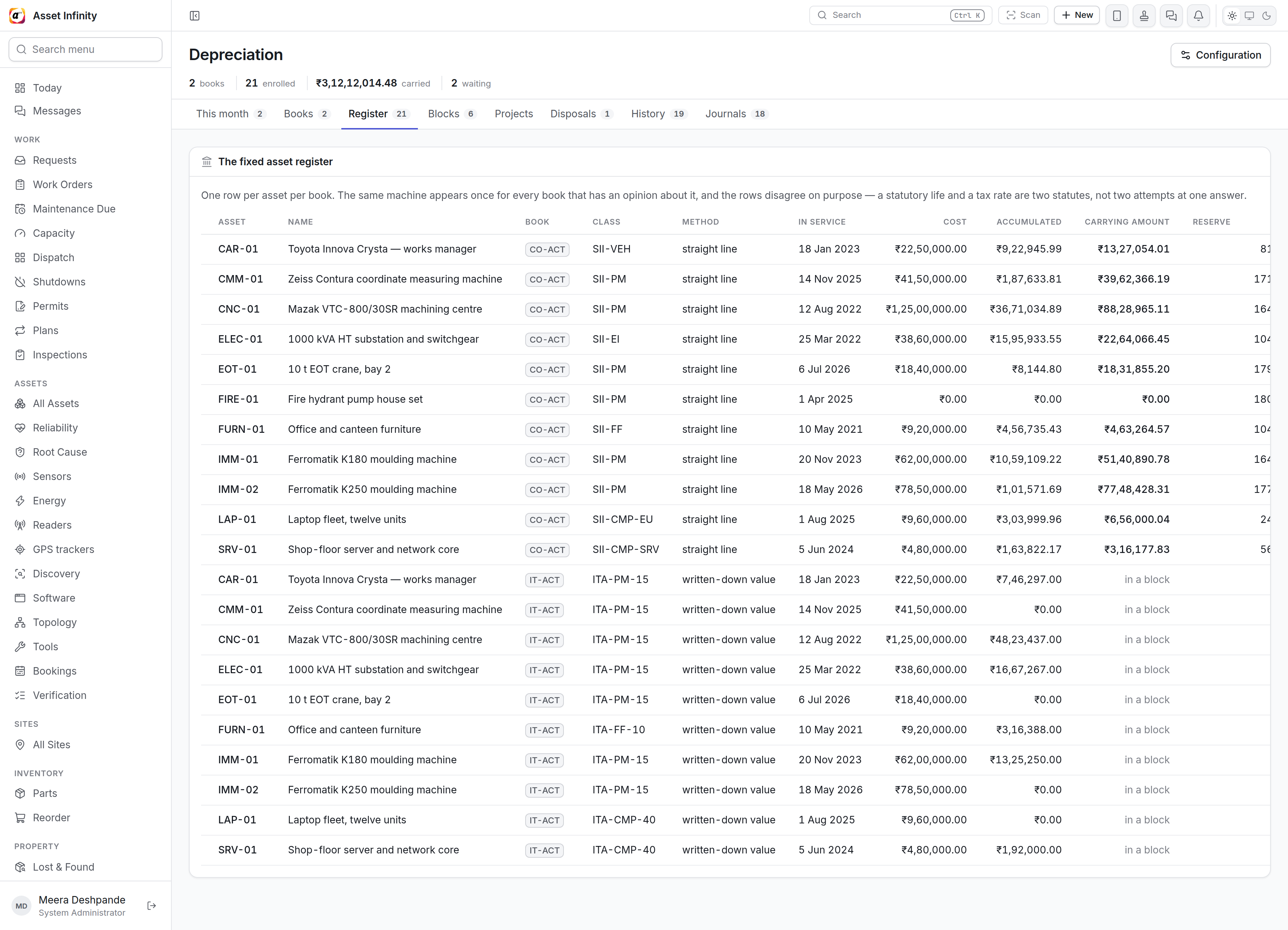
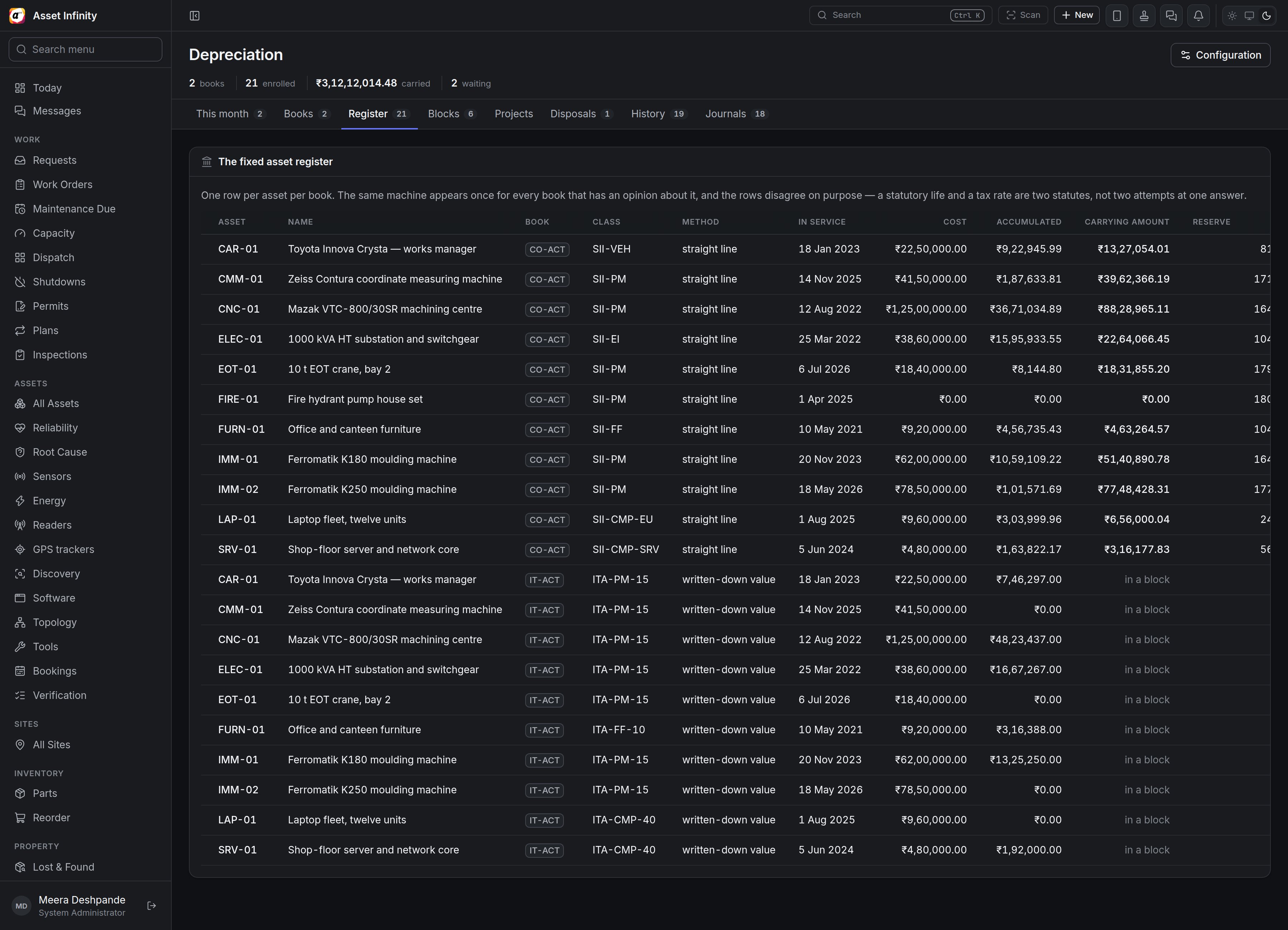 On the **Register** each asset appears once per book — two classes, two methods, two answers. In the income tax book the carrying amount reads **in a block**, because no individual asset inside a block has one.
### The income-tax book: blocks of assets
The tax book is computed once a year, on the **Blocks** tab:
On the **Register** each asset appears once per book — two classes, two methods, two answers. In the income tax book the carrying amount reads **in a block**, because no individual asset inside a block has one.
### The income-tax book: blocks of assets
The tax book is computed once a year, on the **Blocks** tab:
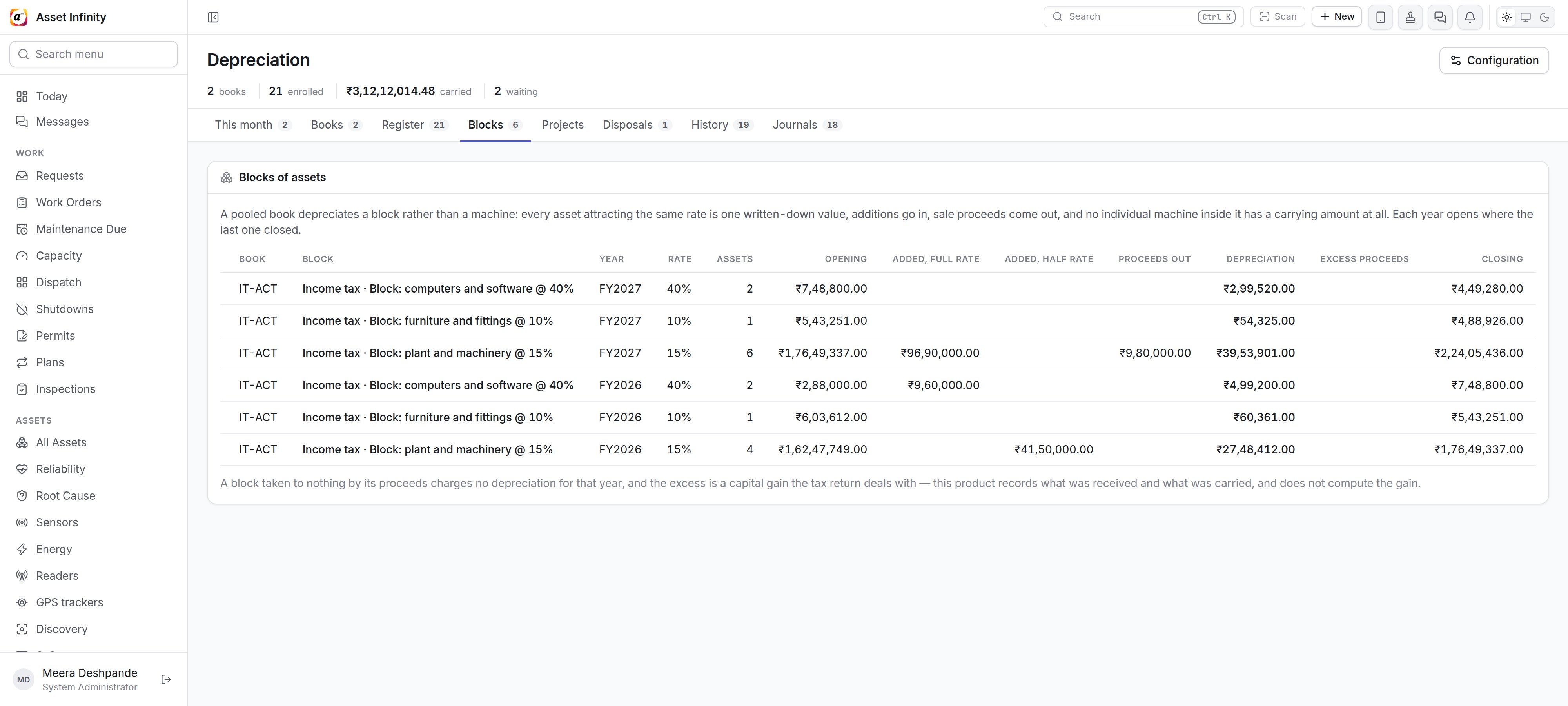
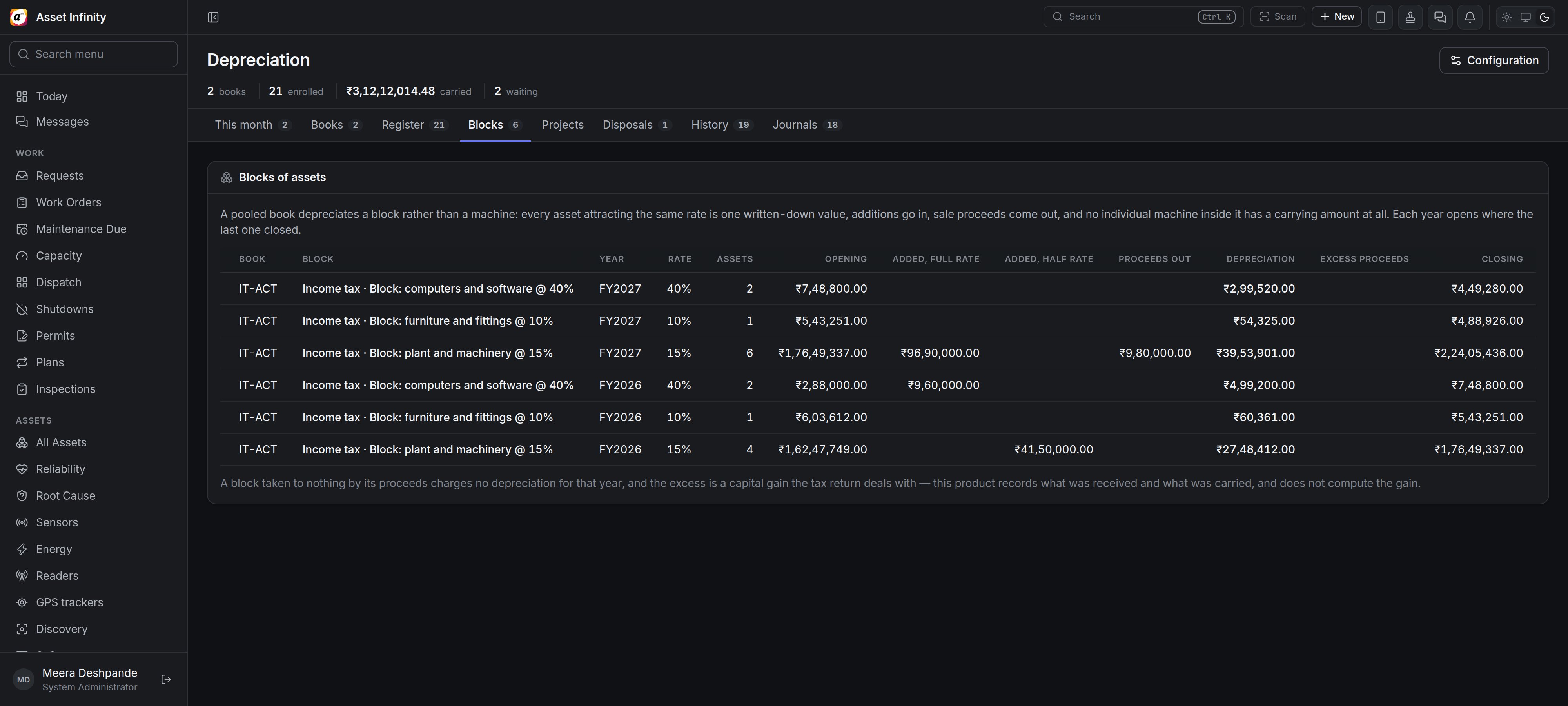 | Column | Meaning |
| - | - |
| **Opening** | Last year's closing written-down value |
| **Added, full rate** | Additions put to use for 180 days or more in the year |
| **Added, half rate** | Additions put to use for fewer than 180 days — half the rate applies to them this year |
| **Proceeds out** | Sale proceeds of assets sold from the block |
| **Depreciation** | The year's allowance |
| **Excess proceeds** | Where proceeds exceed the block, it goes to nil and the excess is a capital gain for your return. The product records it; it does not compute the gain |
| **Closing** | Carried to next year |
The year in progress is a draft until you post it at year end.
### Selling an asset
A sale is recorded once, with **Dispose** on the asset's **Finance** tab, and treated differently in each book:
| Column | Meaning |
| - | - |
| **Opening** | Last year's closing written-down value |
| **Added, full rate** | Additions put to use for 180 days or more in the year |
| **Added, half rate** | Additions put to use for fewer than 180 days — half the rate applies to them this year |
| **Proceeds out** | Sale proceeds of assets sold from the block |
| **Depreciation** | The year's allowance |
| **Excess proceeds** | Where proceeds exceed the block, it goes to nil and the excess is a capital gain for your return. The product records it; it does not compute the gain |
| **Closing** | Carried to next year |
The year in progress is a draft until you post it at year end.
### Selling an asset
A sale is recorded once, with **Dispose** on the asset's **Finance** tab, and treated differently in each book:
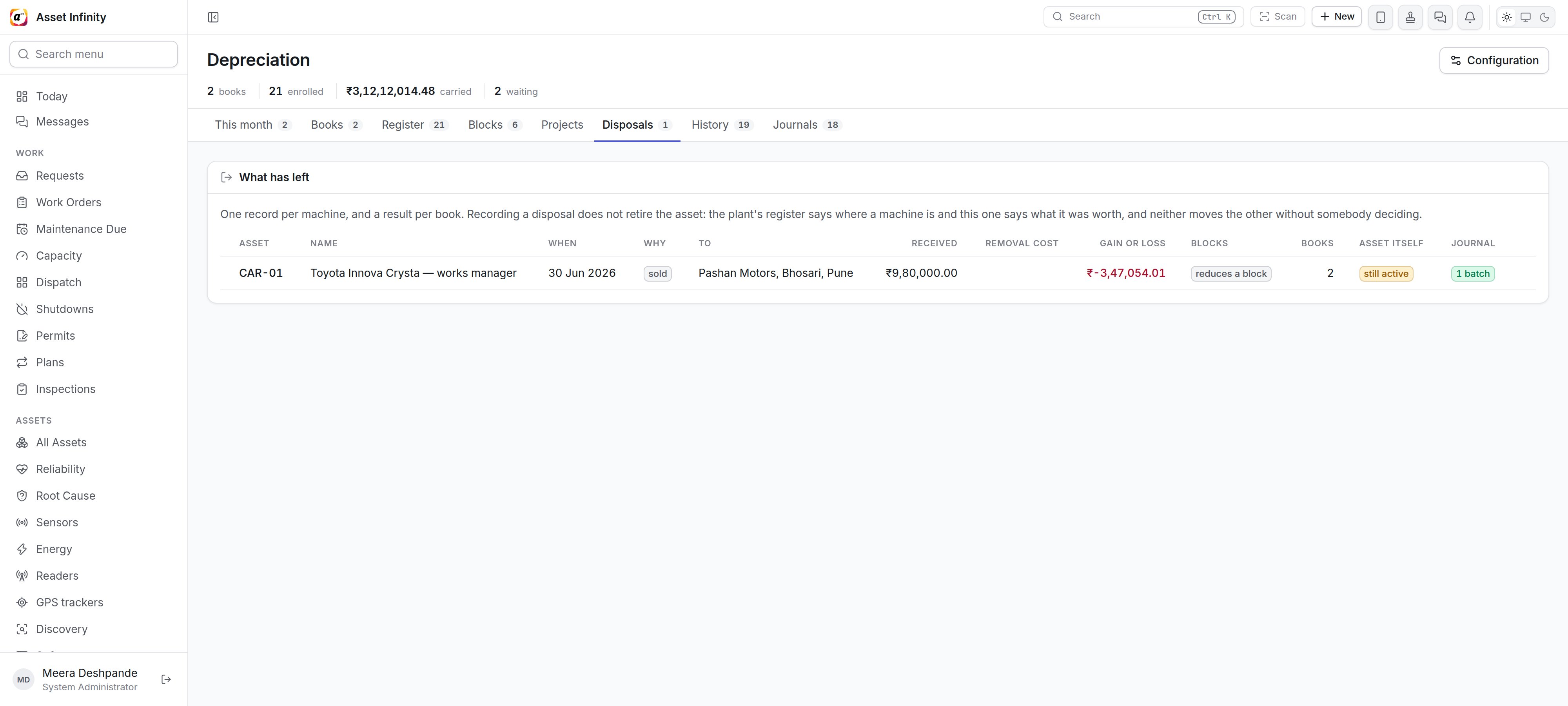
 | Book | Result |
| - | - |
| Statutory accounts | Proceeds against the carrying amount — a gain or loss, with a disposal journal |
| Income tax | The proceeds reduce the block (**reduces a block**); no gain or loss on the asset itself |
The monthly run, register, blocks, projects and journals.
Lines, tax and three-way matching.
This documentation is built and hosted on [Mintlify](https://mintlify.com), a developer documentation platform.
| Book | Result |
| - | - |
| Statutory accounts | Proceeds against the carrying amount — a gain or loss, with a disposal journal |
| Income tax | The proceeds reduce the block (**reduces a block**); no gain or loss on the asset itself |
The monthly run, register, blocks, projects and journals.
Lines, tax and three-way matching.
This documentation is built and hosted on [Mintlify](https://mintlify.com), a developer documentation platform.