

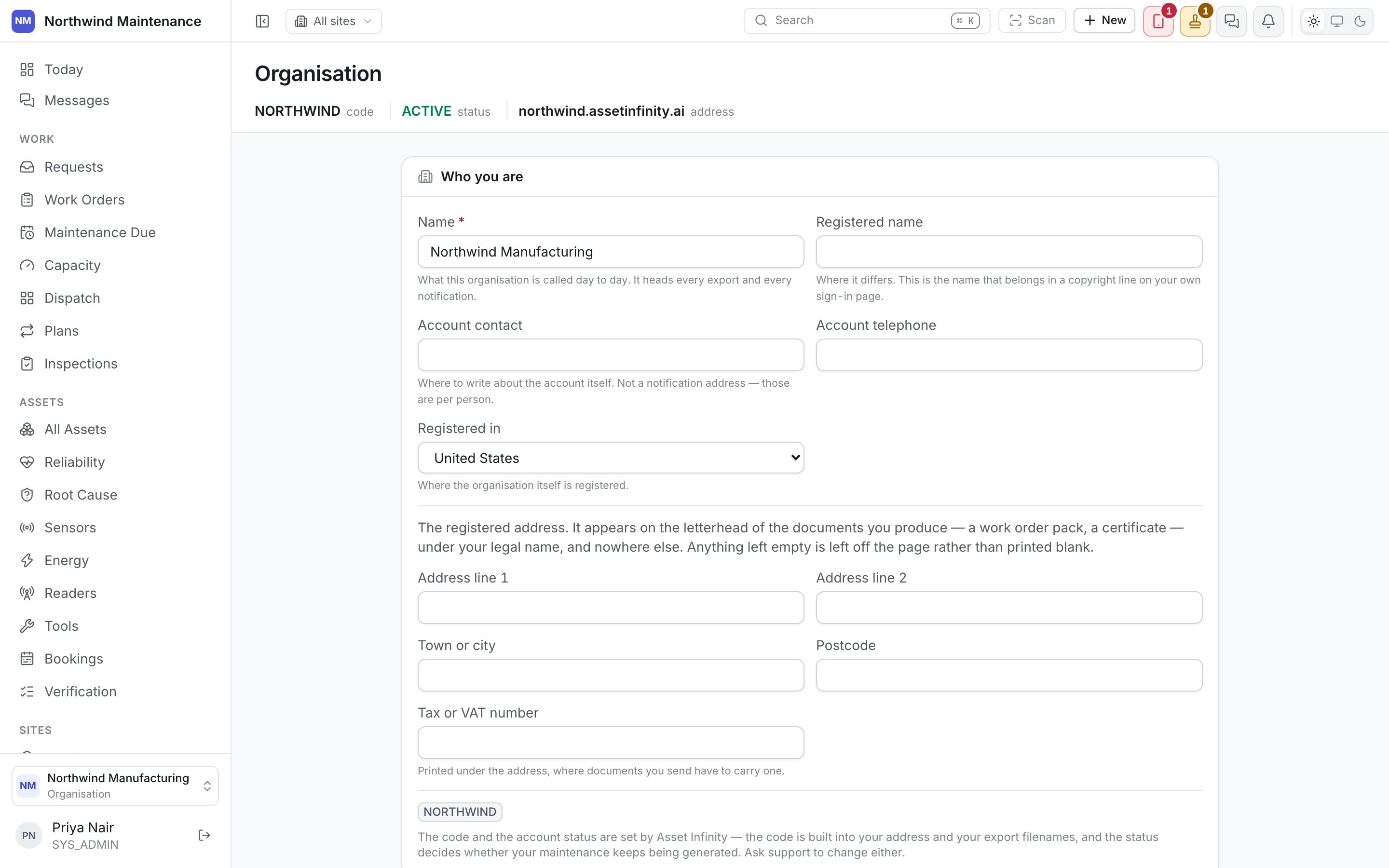
The one screen that sets what the rest of the product assumes by default — what currency a new record is quoted in, what “today” means for planning, how far ahead a plan looks.
These used to be back-office settings, changeable only by the platform team on request. An administrator now edits them directly, under Administration → Organisation.

Identity

The two names differ on purpose. “Acme” is what people read every day; “Acme Manufacturing Private Limited” is what a vendor’s finance team expects on a contract.

Currency

Three currency settings, each answering a different question: A single-country plant usually sets all three the same and never thinks about it again. A group with sites invoicing in different currencies needs the split — costs are still recorded in whatever currency they occurred in, but roll up to one reporting currency at the rate on record. See currency and exchange rates for where those rates come in.

Locale

Default language, locale and timezone for the organisation as a whole — what a new user inherits before they set their own. A person’s own timezone and locale, set on their access record, still wins for them; this is the fallback, not an override.

Planning horizon

How many days ahead planning screens look when generating and forecasting work. Set it too short and a plan cannot see demand that is genuinely coming; set it needlessly long and every planning screen is doing more work than the plant needs.
Match it to your longest planning cycle — the plan that runs least often — rather than your shortest. A weekly PM and an annual shutdown plan can share one organisation; the horizon has to be wide enough for both to show up.

Allow negative stock

Whether a part can be issued past zero on hand. Off by default: a store cannot go negative, and issuing the last one on the shelf is where it stops. Turning it on lets stock go negative rather than blocking the issue — useful where the count is known to lag reality (goods received but not yet booked in) and blocking work over a paperwork gap does more harm than a negative number on a report. It is a policy for the whole organisation, not a per-store exception.

Warranty override

Whether a technician can proceed against an asset under warranty without a separate approval step. Off by default, on the assumption that warranty work should be routed to the vendor rather than performed in-house — doing so can void the cover. Turning it on lets work proceed straight through, which some plants want for minor jobs where the paperwork costs more than the risk.
This is an organisation-wide switch, not a per-asset one. Turn it on because most of your fleet needs it and you accept the risk on the rest, not because one asset is being awkward.