

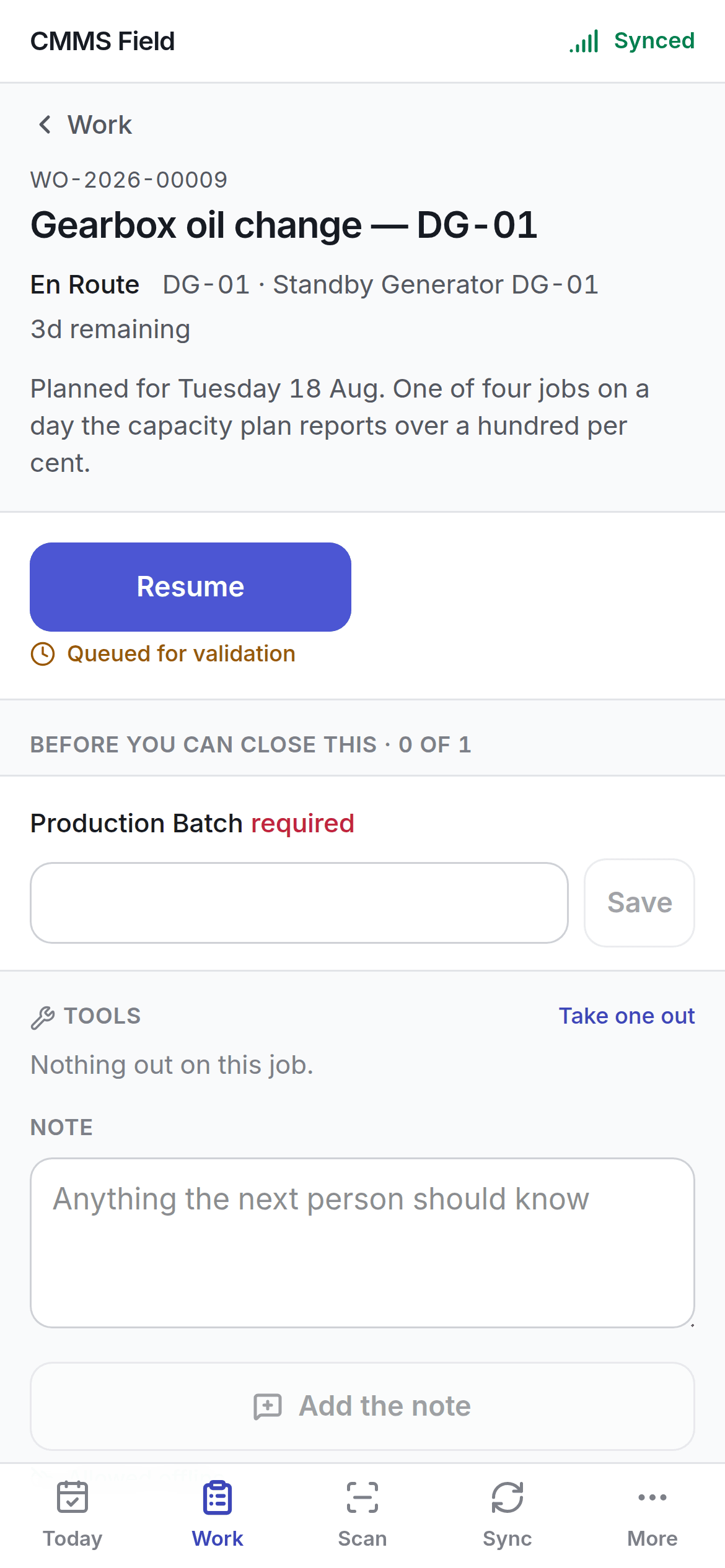
The rule of this screen
Pressing a button changes the screen now. The job updates immediately, the change goes into a queue, and a chip tells you the server has not agreed yet. Nothing waits for a network, because there usually is not one.Moving the job along
The action button offers what your organisation’s state model allows next — Accept, Depart, Start work, Put on hold, Wait for parts, Resume, Complete. See the lifecycle. Under it, a chip says where the change has got to:Before you can close this
Anything the job still needs before it can be closed is listed with a count — a mandatory checklist step, a required custom field, a reading. The job cannot be completed until these are done, and saying so up front beats discovering it after packing up.The checklist
Steps in order, with the mandatory ones marked. Tick them as you go. A step may require evidence — a photograph, a signature or a measurement. Capture it on the spot; photographs travel separately from the rest of the queue, so a big image does not hold up a status change.Recording as you work
Parts
Parts
What you actually used. This reduces stock, costs the job, and feeds the consumption history
reorder forecasts from.
Hours
Hours
Time on the job, against the rate that applies to you.
Meter readings
Meter readings
Run hours, cycles, pressures. Take them while you are standing at the counter — it is the most
reliable moment there is. See meters.
Tools
Tools
Take an instrument out against the job, and hand it back when done, so the register knows where
it is.
Notes
Notes
Anything the next person should know. Notes are the cheapest thing on this screen and the most
read.